USE CASES

Mortgage Underwriting Automation

MightyBot runs a GSE conventional delivery-eligibility pre-screen on first-lien 1-4 unit mortgages that could be sold to Fannie Mae or Freddie Mac so compiled floors execute and underwriters keep the judgment.

What is mortgage delivery-eligibility screening?

Agents on the MightyBot platform run a GSE conventional delivery-eligibility pre-screen for first-lien 1-4 unit mortgages that could be sold to Fannie Mae or Freddie Mac, calculating income and DTI with evidence trails and returning delivery-eligible, ineligible, or refer from compiled floors.

Why the AUS leaves the reading to the underwriter

For financial services teams, a single mortgage file spans dozens of document types. The underwriter extracts data from each document, cross-references the package, and evaluates it against layered guidelines: Fannie Mae and Freddie Mac delivery floors, plus lender overlays.

Hard floors — occupancy, conforming limits, LTV, credit score, DTI, reserves, evidence clocks — should compile the same way on every conventional file. Self-employed cash-flow stability, short history, declining income, and variable-income continuance stay open judgment. Volume spikes create backlogs. QC adds another layer. Missing or stale evidence cannot stamp a file delivery-eligible.

Document volume

Large files across dozens of document types

Layered guidelines

GSE delivery floors plus lender overlays, all interacting

Income complexity

Self-employed, co-borrower, and variable income — cash-flow arithmetic compiles; stability stays open

Volume volatility

Rate-driven waves overwhelm manual capacity

QC burden

Re-underwriting closed files creates repurchase risk if missed

How MightyBot Executes It

Every step. Automated.
Every calculation. Traced.

  1. Full File Document Processing

    Ingestion & Classification

    Entire mortgage file ingested and classified simultaneously. Every document type routed to specialized extraction. Missing, stale, or conflicting required evidence cannot produce a delivery-eligible stamp. Consistent structured data. In parallel.

  2. Agency Guidelines as Executable Policies

    Guideline Enforcement

    Policies written in plain English compile into deterministic execution. Occupancy, property, purpose, conforming loan limits, LTV/CLTV/HCLTV, representative credit score, DTI, reserves, and required evidence clocks are hard floors on conventional GSE files. Other agency guidelines can be modeled as policies. Updates deploy centrally and run on the next file.

  3. Automated Income Calculation

    Income Analysis

    Income extracted from pay stubs, W-2s, and tax returns. Self-employed: Schedule C, K-1, 1120-S, 1065 with add-backs and trending. The cash-flow worksheet compiles; stability, short self-employed history, declining income, and variable-income continuance stay open. Thin write-ups refer. Every calculation shows source documents and methodology.

  4. DTI, LTV, and Disposition

    Evaluation

    DTI, LTV, CLTV, and HCLTV computed with evidence trails linking every input to source. Conventional GSE files return delivery-eligible, ineligible, or refer. A labeled AUS finding is an input, never a live engine call, and never the official action.

Use-case map

How Mortgage Underwriting Automation works in MightyBot

MightyBot runs a GSE conventional delivery-eligibility pre-screen on first-lien 1-4 unit mortgages and returns a disposition, findings memo, and audit record.

Inputs Mortgage files, income documents, bank statements, credit reports, appraisals, labeled AUS findings, agency guidelines, and lender overlays.
Execution Classifies the file, extracts borrower facts, compiles GSE delivery-eligibility floors and overlays from plain English, calculates income and DTI, and leaves self-employed and variable-income judgment open.
Outputs Delivery-eligible, ineligible, or refer disposition, underwriting-findings memorandum, and exportable audit record.
Audit trail Every gate records the Selling Guide or Freddie Guide cite, evidence pointer, observed value, threshold, result, and whether a rule or a reviewer computed it.
Best for Mortgage teams handling large files, GSE delivery-eligibility floors, self-employed borrower complexity, guideline changes, and QC pressure.

Sources

Sources and verification

Regulatory references were read in the original documents and last verified September 17, 2026. Production figures come from the named MightyBot deployment.

"We automated what no one else could."

The platform compiles GSE delivery-eligibility floors on occupancy, loan limits, LTV, credit score, DTI, reserves, and evidence clocks. Self-employed cash-flow stability and variable-income continuance stay open for the underwriter.

95%
Time reduction in production Built Technologies — Production Deployment

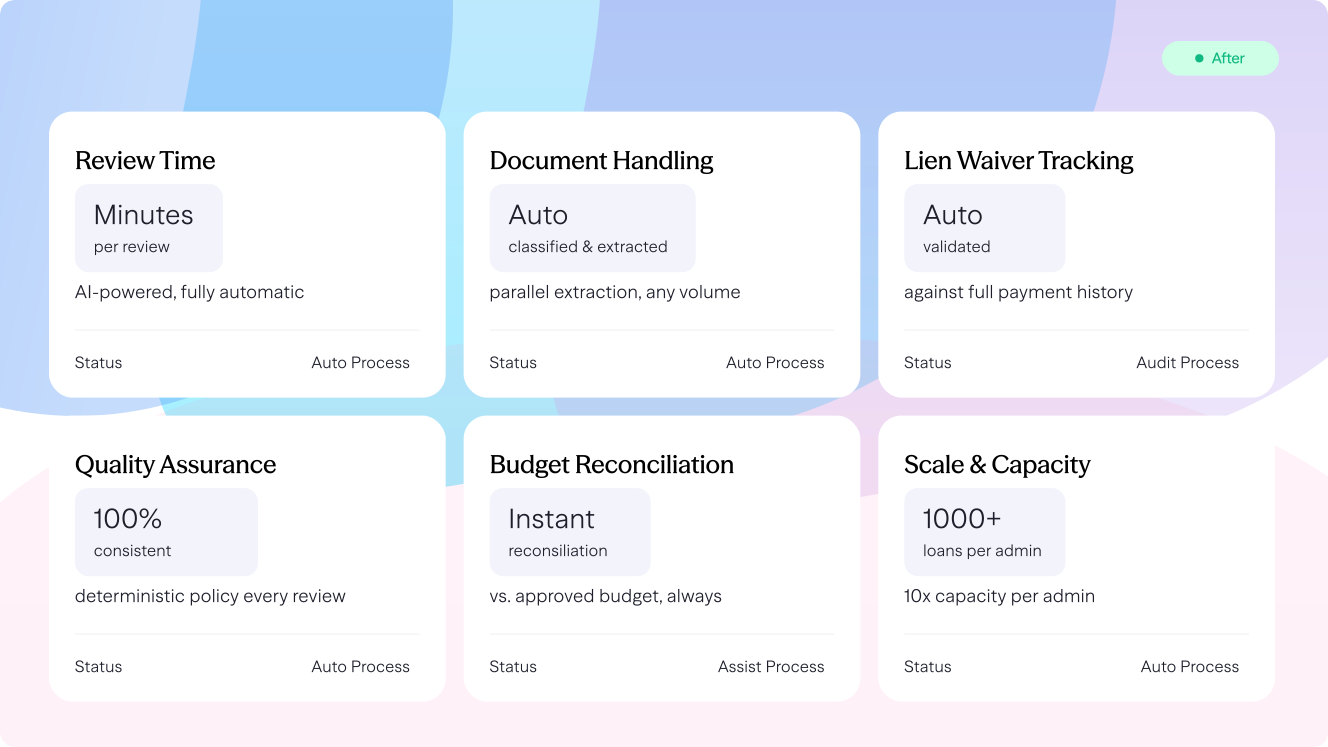
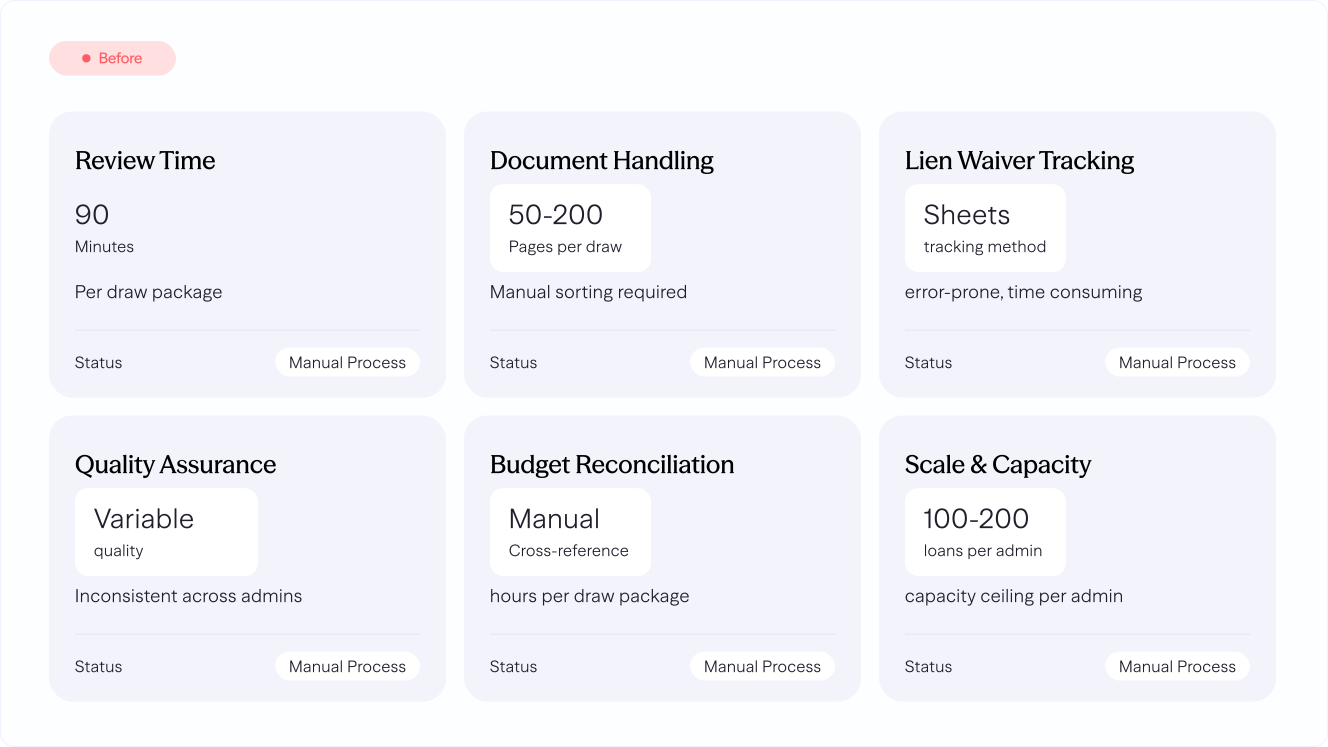
Before vs After

After Before

Buyer's guide

How to automate mortgage underwriting document review without replacing the AUS or the underwriter

What does the underwriter still do by hand after the AUS runs?

Desktop Underwriter and Loan Product Advisor return a recommendation and a list of conditions. They do not read the file. Fannie Mae's guide says "DU indicates the minimum income verification documentation required to process a loan application," and that "The lender must determine whether additional documentation is warranted." The OCC's Residential Real Estate Lending handbook puts it plainly: "Mortgage loan processing consists of information or data gathering and verification."

So the underwriter opens pay stubs, W-2s, tax returns and transcripts, bank statements, gift letters, the appraisal, title and insurance, checks each against the application and the AUS conditions, calculates qualifying income, sources large deposits, and writes the conditions the file still needs. On a distributed team with no single procedure, two underwriters can clear the same file differently.

The stakes are delivery and repurchase. If a resubmission to DU results in an ineligible recommendation, "the mortgage loan may not be delivered to Fannie Mae." For FHA loans, HUD's Handbook 4000.1 says "The Mortgagee may not accept or deny an FHA-insured Mortgage based solely on a risk assessment generated by TOTAL Mortgage Scorecard."

How do AI agents pre-screen a mortgage file and document every finding?

On MightyBot, agents classify every document in the file, extract the fields the guidelines call for, and keep a pointer to the page and position each came from. Income is calculated under your written policy for each income type, assets are traced with large deposits flagged, and the appraisal is checked for the fields and conditions your policy requires. Each value carries a confidence score, and low-confidence values route to a person.

Delivery-eligibility rules and your overlays are written as plain-English policies and compiled into checks. The agent returns a disposition, a findings memo listing every check as passed, failed or missing, and the conditions to request, before or alongside the AUS run. The underwriter decides; the file arrives with the reading done.

The record keeps the policy version, the inputs with their sources, the confidence and review on each value, and the underwriter's decision, which is what post-closing QC, investors and examiners ask to see. The same pipeline runs commercial loan underwriting and CRE lending.

What do the rules require on verification, appraisal review and adverse action?

Regulation Z's ability-to-repay rule requires a creditor to verify income and assets "using third-party records that provide reasonably reliable evidence of the consumer's income or assets," and notes that "A creditor may verify the consumer's income using a tax-return transcript issued by the Internal Revenue Service (IRS)." Fannie Mae requires the lender to "obtain a signed and complete appraisal report that accurately reflects the market value, condition, and marketability of the property."

Appraisal review has an independence rule. The Interagency Appraisal and Evaluation Guidelines say reviewers should "be independent of and insulated from any influence by loan production staff." Quality control closes the loop: the OCC expects that "the QC unit tests a sample of closed loans from all origination channels."

When a file is declined, Regulation B requires that the statement of reasons "must be specific and indicate the principal reason(s) for the adverse action," and that saying the applicant "failed to achieve a qualifying score on the creditor's credit scoring system" is insufficient on its own. A finding tied to a document and a rule is what a specific reason looks like.
What to look for in mortgage underwriting automation software

Use these questions when you compare loan packet automation and pre-screen tools.

  • Does it read the whole packet?Pay stubs, W-2s, 1040s and transcripts, bank statements, gift letters, appraisal, title and insurance, as scans and PDFs from many sources.
  • Does it calculate income under your policy?Salaried, hourly, variable, self-employed and rental income each have rules. The calculation and the rule should be visible, versioned and traceable to the documents.
  • Are findings tied to pages?Every condition, exception and calculated figure should link to the document page it came from, with a confidence score and the reviewer's action.
  • Does it work with the AUS rather than around it?Findings should map to DU or LPA conditions and to your overlays, and the tool should never issue a decision on its own.
  • Does it produce the memo and the QC record?A findings memo for the underwriter and an exportable record for post-closing QC, investors and examiners.
  • Does it make distributed teams consistent?The same checks in the same order on every file, regardless of which branch or underwriter picks it up.

Manual review, document extraction tools and a policy-driven platform compared

CriterionManual file reviewDocument extraction toolPolicy-driven AI agent platform
Reading the packetUnderwriter reads every page.Fields extracted; checks left to the underwriter.Documents classified, extracted and normalized with source pointers and confidence.
Income and assetsCalculated by hand on a worksheet.Extracted values; calculation elsewhere.Calculated under your written policy, with the rule and sources shown.
Eligibility and overlaysChecked against a checklist.Outside the tool.Every rule tested on every file; disposition, memo and conditions produced.
Consistency across teamsVaries by underwriter and branch.Consistent extraction only.Same checks everywhere, versioned.
QC and investor recordRebuilt from the file.Extraction log.Value-level sources, policy version, reviewer and timestamps.
Fits best whenLow volume.Data entry is the only bottleneck.Volume, multiple channels, and repurchase or examination exposure.

Loan files processed. Delivery-eligibility floors compiled. Underwriters keep the judgment.

FAQ

Frequently Asked Questions

What is mortgage delivery-eligibility screening?

A GSE conventional delivery-eligibility pre-screen evaluates first-lien 1-4 unit mortgages that could be sold to Fannie Mae or Freddie Mac against compiled floors: occupancy and property, conforming loan limits, LTV/CLTV/HCLTV, representative credit score, DTI, reserves, and required evidence clocks. Official outcomes are delivery-eligible, ineligible, or refer. The delivery-floor pass (APPROVE_ELIGIBLE) is this pre-screen’s result; it is not Desktop Underwriter Approve/Eligible and not LPA Accept. Agents on the platform calculate income and return the disposition, findings memo, and audit record. Delivery-eligibility is not a credit approval.

What do AI mortgage underwriting agents do?

They read the full loan file, calculate qualifying income (including self-employed borrowers), compile delivery-eligibility floors and lender overlays, flag missing required evidence, and assemble findings with evidence links. A labeled AUS finding is an input, never a live engine call. Approval authority stays with the underwriter. The platform does not approve the loan, compute LLPAs, or quote MI.

Can MightyBot handle self-employed borrower income?

Yes. 1040, Schedule C, 1120-S, 1065, and K-1 documents are processed with agency-specific add-backs, trending, and declining-income flags documented. The cash-flow worksheet compiles; cash-flow stability, short self-employed history, and declining income stay open. Thin write-ups refer.

How does MightyBot stay current with agency changes?

Guidelines are written in plain English and compiled into deterministic execution. When Fannie or Freddie publish updates, the policy changes centrally and all new files evaluate against the latest rule set immediately.

Does MightyBot support lender overlays?

Yes. Lender-specific overlays can be layered on top of agency guidelines so the platform evaluates both and shows which policy drove each finding.

Can MightyBot automate post-close QC?

Not this pre-screen. Post-close QC is a later desk activity. This workflow returns the delivery-eligibility disposition, findings memo, and audit record. It does not re-underwrite closed files or rate repurchase risk.

How does MightyBot handle AUS findings?

A labeled Desktop Underwriter or LPA finding is a structured input, never a live engine call, and never the official action. The platform cross-references it against the file and evaluates it alongside compiled delivery-eligibility floors. Delivery-eligible on this pre-screen is not DU Approve/Eligible and not LPA Accept.

What about non-QM and portfolio products?

Bank statement programs, asset depletion, DSCR investor loans, and other portfolio products can be modeled as policies on the same platform.